by Torben Gronning, Patricia Sohl and Thomas Singer
Visual Resources Vol. XXIII, No. 3, September 2007, pp. 245-267
This article describes the history of the recently digitized and online accessible Archive for Research in Archetypal Symbolism (ARAS), from its 1930s origins at the famous Eranos annual conferences of eminent scholars in Ascona, Switzerland to the present. The purpose, function and structure of the collection are explained and illustrated with an example. ARAS is compared with other art image databases, and its unique features are elucidated. The article argues that the heritage and focused purpose of ARAS has allowed it to successfully address common iconographic challenges and that the online resource (www.aras.org) adds important new dimensions to the user experience.
Keywords: Iconography; archetypal symbolism; cross-cultural symbols; Fröbe-Kapteyn, Olga (1881-1962); Jung, Carl Gustav (1875-1961).
Introduction
When a filmmaker needed inspiration for her award-winning animated film, she found it in the Archive for Research in Archetypal Symbolism. When a theater director looked for ideas for sets and costumes, he consulted the archive, as did an artist developing a survey of masks throughout world history and a theologian looking for an androgynous figure of Christ. Numerous analytical psychologists and psychotherapists regularly consult the archive to explore their own and their clients' dreams by analyzing the symbolic imagery of these dreams in a process of self-discovery.
The Archive for Research in Archetypal Symbolism, often just called ARAS, has a most interesting history, rooted in the Eranos meetings of the early 1930s, when world-renowned scholars from many fields gathered for discussions that touched on the history of religion, the history of art, anthropology, psychology, sociology and archaeology. Images to illustrate the topics of these cross-disciplinary meetings formed the beginning of the ARAS archive, and the Eranos heritage became the foundation for developing the nomenclature used in ARAS's image classification.
ARAS has since developed into a rich collection of 17,000 annotated photographic images of human creative expression, purposefully selected from every culture, spanning the 30,000 years of human history since the Ice Age. With its cultural, historical, anthropological and psychological commentary, ARAS has become over time a unique tool for academics, researchers, scholars, artists, writers, historians, anthropologists, analytical psychologists, psychotherapists, students, and the general public alike.
Early History of ARAS and Eranos
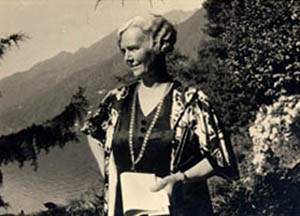
The conception of ARAS dates back to the 1930s and is intrinsically linked to the Eranos Society and its creator, Olga Fröbe-Kapteyn (Figure 1). She was born in 1881 of Dutch parents in London where her father Albert Kapteyn, an avid photographer, was the director of the Westinghouse Brake and Signal Company. Her mother was a philosophical anarchist, a writer on social questions, and a friend of playwright George Bernard Shaw and anarchist Prince Kropotkin. Olga Fröbe-Kapteyn studied applied art in Zürich and helped in her father's darkroom. She became a young widow when her husband Iwan Fröbe, the Austrian musician, was killed in a plane crash in 1915 while testing an aerial camera for the Austrian army. She had twin
 Figure 1 Olga Fröbe-Kapteyn in the 1930s. Photograph by Margarethe Fellerer. Courtesy of Eranos Foundation Archives, Ascona-Moscia, Switzerland. |
daughters, born after the death of her husband.1
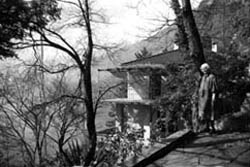
Around 1920, Olga Fröbe and her father went for a recreational stay to the Monte Verita sanatorium in the Swiss village of Ascona, located on the western bank of Lake Maggiore, a setting of great natural beauty looking south into Italy. Ascona had since the late nineteenth century developed into a gathering place for artists, writers, dancers, political radicals, utopians and gurus, including Lenin, Trotsky, Mikhail Bakunin, Prince Kropotkin, Hermann Hesse, Stefan George, Rudolf Steiner, Mary Wigman, Isadora Duncan, Hans Arp, Paul Klee, Emil Jannings, Emil Ludwig, and Erich-Maria Remarque. Albert Kapteyn bought a house overlooking the lake, Casa Gabriella (Figure 2), for his daughter and provided funding for her to live in reasonable comfort.
Olga Fröbe's great interest was spiritual research, and she built a lecture hall and a guesthouse on her grounds in 1928. After a short and unsuccessful attempt at running a school for spiritual research, she developed the idea of founding a meeting place for East and West. In 1932 she went to Marburg to visit Rudolf Otto, the prominent German theologian, scholar of mysticism and comparativist of Eastern and Western religions. Otto was very receptive to her plan for a lecture program and proposed the name "Eranos," which in Greek means a shared feast.
For the next sixty-six years this annual lecture program, begun in August 1933 and called the "Eranos Tagungen" (Eranos meetings), would assemble many of Europe's leading intellectuals in Ascona to give scholarly lectures about their latest insights in the fields of religion, philosophy, history, art and science. The imaginative and inspiring force
 Figure 2 Casa Gabriella, Ascona, Switzerland in the 1950s. Photograph by Margarethe Fellerer. Courtesy of Eranos Foundation Archives, Ascona-Moscia, Switzerland. Archetypal Symbolism and Images 247. |
of mind and the unfailing rigor of scholarship2 brought forward ideas often "on the edge."3 The lectures were published after each year's conference in the Eranos- Jahrbuch (Eranos Yearbook).4 Olga Fröbe-Kapteyn was the publisher of each Eranos yearbook from 1933 to 1961, the year before her death. Six volumes of selected Eranos lectures, translated into English and edited by Joseph Campbell, were published in 1954-1968 as part of the Bollingen Series.5
The subject of the first two-week Eranos conference in 1933 was "Yoga and Meditation in East and West," held in the lecture hall now named "Casa Eranos." Among the speakers were the scholars of Indian art and religion Heinrich Zimmer and G.R. Heyer, the Buddhist scholar Caroline Rhys Davids and the Sinologist Erwin Rousselle.6
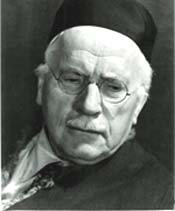
Psychiatrist and founder of analytical psychology Carl Gustav Jung (Figure 3), reluctant at first, decided to participate when he saw the lecturer list and realized that "those are all my friends!"7 Jung would become a regular contributor each year to the two-week conference in late August. Jung remained a fundamental figure in the organization of the conferences due to the fertile influence of his analytical psychology-referred to as a "spiritus rector" by Eliade in 1955. Although
 Figure 3 Carl Gustav Jung in the late 1940s. Photographer unknown. Courtesy of Thomas B. Kirsch, MD, Palo Alto, CA. |
the symposia were not "Jungian," they focused on the core idea of "archetypes" in human life.8
Despite the difficulties of the pre-war years, the Eranos conferences took place without interruption. Planning for next year's conference would begin as soon as one year's conference was over. Olga Fröbe was the impresario and organizer, although she insisted that Eranos was without plan or program. She decided the theme, invited the speakers, organized the announcements and printing of programs, booked accommodations, planned catered lunches and dinners, made traffic arrangements with local authorities.
A conference typically included anywhere from seven to twelve half-day lectures, delivered in German, French or English, and attended by up to two hundred persons. The afternoons were open for informal discussions, sailing on the lake, excursions in the area or reading. An equal representation of first-time speakers and speakers with previous Eranos experience assured renewal and continuity through the years.
The scholars from the early years and their expertise demonstrate the cross-cultural nature of the Eranos experience: Heinrich Zimmer (Indian religious art), Károly Kerényi (Greek mythology), Mircea Eliade (history of religions), Jung and Erich Neumann (analytical psychology), Gilles Quispel (Gnostic studies), Gershom Scholem (Jewish mysticism), Henry Corbin (Islamic religion), Adolf Portmann (biology), Herbert Read (art history), Max Knoll (physics) and Joseph Campbell (comparative mythology).9
Olga Fröbe had a lively interest in finding and collecting images to illustrate the topic of each year's meeting, which in addition to the first year's "Yoga and Meditation in East and West" (1933) included such titles as "The Gestalt and Cult of the Great Mother" (1938), "The Hermetic Principle in Mythology, Gnosis, and Alchemy" (1942), "The Mysteries" (1944), "Spirit and Nature" (1946) and "Man and Time" (1951).10
In 1935 she systematically began to collect pictures that exemplified archetypal themes as a complement to Jung's writings. She later explained that "Those who feel the truth of the old Chinese conception that all that happens in the visible world is the expression of ideas or images in the invisible might do well to consider Eranos from that point of view." She traveled to the great libraries in Athens, Rome, Paris, London and elsewhere in Europe, finding and purchasing photographs of ancient frescoes and other paintings, sculpture, manuscript illumination and primitive folk art. These she classified according to archetypal themes in what became known as the "Eranos Archive," located for want of other space in her bedroom at Casa Gabriella.11
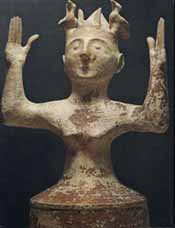
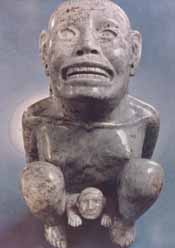
The 1938 Eranos conference on "The Great Mother" included an exhibition of large photographs from the Eranos Archive (Figure 4). Hildegard Nagel took the pictures back for an exhibition at the Analytical Psychology Club in New York, thus facilitating Eranos' debut in America.12 The exhibited pictures later became the basis of Erich Neumann's book The Great Mother: An Analysis of the Archetype (New York: Pantheon, 1955). Figures 5, 6 and 7 show expressions of the Great Mother archetype from three different cultures and time periods.
With financial assistance from benefactors Mary and Paul Mellon of Pittsburgh, both deeply involved in Eranos and later the founders of the Bollingen Foundation Archetypal Symbolism and Images 249 created to assure a wider audience for Jung's work,13 Olga Fröbe traveled to Rome in 1938 to obtain photos of an illuminated manuscript of the Divine Comedy kept in the Biblioteca Apostolica Vaticana Library.14 She wrote to Mary Mellon that she was "going to collect every archetypal representation I can find, ... [e.g.] the Crucifixion, the Baptism, the Descent into Hell, the Resurrection, the fight with the Dragon." She continued to Amsterdam, London, Paris, Bonn, Trier and Berlin, "picture-hunting everywhere."15
At the start of the Second World War, Olga Fröbe was contemplating what to do with her Eranos archive. She learned of the Warburg Institute - moved in 1934 to London from Hamburg because of the Nazi danger - and its library, which seemed a good fit for her collection. After the war, in 1946, she began to send her photographs to London, and in 1956 the Warburg Institute accepted her entire collection. She gave photographic duplicates of the archive (made at Bollingen expense) to Jung (who shortly before his death gave it to the Jung Institute in Zürich) and to the Bollingen Foundation in New York, which was, at that time, supporting numerous scholars in their quest for the meaning of symbolism and publishing the works of Jung.16
Jessie E. Fraser, Librarian of the Analytical Psychology Club in New York, was entrusted with editing and cataloging the archive. In 1959, her proposal for a cataloging scheme found support with members of the Eranos Conference, and the Bollingen Foundation decided to make the archive a special project and increase their grant.17 In 1960, the archive was renamed the Archive for Research in Archetypal Symbolism (ARAS), reflecting the many additions to the original Eranos collection.
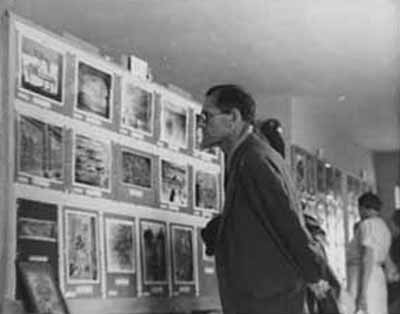
 Figure 4 Swiss journalist and publicist Fritz René Allemann viewing the Eranos Archive in 1939, featuring archetypal representations related to the process of rebirth. (The Eranos Conference 1939 was entitled "The Concept of Rebirth in the Cults and Religions of Various Times and Peoples.") Photograph by Margarethe Fellerer. Courtesy of Eranos Foundation Archives, Ascona-Moscia, Switzerland. |
In the development of keywords to reflect archetypal themes, Jessie Fraser collaborated with analytical psychologist Joseph L. Henderson in San Francisco, who worked with Jung and wrote a chapter in Man and His Symbols.18
In 1969, the Bollingen Foundation gave ARAS to the C.G. Jung Foundation for Analytical Psychology in New York, who undertook a ten-year development project funded by Jane Abbott Pratt and the Frances G. Wickes Foundation. The archive grew and had, in 1977, reached 25,000 representations, of which 12,000 were mounted, numbered and in various stages of completion and 8,000 finished.19 Copies of the collection were housed at the C. G. Jung Institutes in San Francisco and Los Angeles. These three Jungian centers are the founding members of National ARAS.
The Bingham Foundation and many other donors were instrumental in supporting the continued expansion of the collection in the 1980s, and also made possible the writing and publication of two scholarly volumes, Encyclopedia of Archetypal Symbolism I-II, based on approximately 200 selected images from ARAS.20
In 2003-04, the New York collection of 17,000 images and 20,000 text
 Figure 5 The Goddess Ninhursag ("Lady of Birth") c.2017-1763 BC. Terracotta, 10.2 cm high. Origin: Babylonian Period, Return of Amorites to Babylonia, Time of Isin and Larsa Dynasties. Provenance: Iraq. ARAS Record 2Bh.004. Repository: Iraq Museum, IM 9574, Baghdad, Iraq. |
commentaries was scanned. About 45,000 catalog cards from the New York and San Francisco collections, which had continued its own further development since the early 1980s, were combined to produce 10,000 different keyword-based archetypal themes. Private donors funded this large project that ultimately resulted in ARAS becoming available as an online subscription-based resource (www.aras.org) in 2005.
Purpose of ARAS: Use and Amplification of Symbols and Images
Although the creation of the Archive for Research in Archetypal Symbolism was motivated by Jung's discovery and description of the "archetype," the use of ARAS goes well beyond Jungian psychology. However, ARAS owes a tremendous debt to Jung's basic idea of archetypes and the collective unconscious. Jung was the particular proponent of a broadly archetypal point of view that insists upon common human or transpersonal and symbolic connections transcending cultural and theological boundaries.21
One might argue that from an iconographic classification point of view Jung's concepts have created the essential foundation for the nomenclature
 Figure 6 Minoan Deity or Worshipper. Terracotta. Origin: Pre-Hellenic Era, Crete, Post Palace Period, Late Minoan IIIa, b, c (Achaeans in Crete). ARAS Record 3Ce.002. Courtesy of Archeological Museum Herakleion, Crete, Greece. |
developed to categorize the ARAS image content. The term "archetype" means "original pattern from which copies are made," and it appeared in European texts as early as 1545. It derives from the Latin noun archetypum and from the Greek noun arkhetypon, meaning "pattern, model," and the adjective arkhetypos, meaning "firstmolded," from arkhe- ("first") + typos ("model, type, blow, mark of a blow").22
Jung explains how the collective unconscious-humankind's shared psychic foundation patterning all expressive endeavors-rests on "archetypes" or "primordial images" (CW 8: 229).23 Jung was not the first to discover and formulate this idea of the archetype. Anthony Stevens explains how Jung acknowledged his debt to Plato, describing archetypes as "active living dispositions, ideas in the Platonic sense, that perform and continually influence our thoughts and feelings and actions" (CW 8: 154).24
For Plato, "ideas" were mental forms superordinate to the objective world of phenomena. They were collective in the sense that they embody the general characteristics of groups of individuals rather than the specific peculiarities of one. Thus, a particular dog has qualities in common with all dogs (which enable us to classify it as a dog) as well as peculiarities of its own (which would enable its master
 Figure 7 The Goddess Tlazolteotl. Aplite speckled with garnets, 20.2612 cm. Provenance: Mexico. Origin: Mexico, Aztec. ARAS Record 8Bd.017. # Dumbarton Oaks, Pre- Columbian Collection, Washington, DC. |
to recognize it). So it is with the archetypes: they are common to all humankind, yet each person experiences them in a unique and personal way.
The German astronomer Johannes Kepler (1571-1630) believed that his delight in scientific discovery was due to the mental exercise of matching ideas or images already implanted in his mind by God with external events perceived through his senses. Kepler's "inner ideas" that lie "under the veil of potentiality" and are "derived from a natural instinct and are inborn" are clearly akin to Jung's "primordial images."25 It is speculated that Jung may have been influenced in his thinking about archetypes by the German ethnologist Adolf Bastian (1826-1905), who studied the myths, folklore and customs of humankind all over the world. Bastian was impressed by the similarity, which existed between many of the themes and motifs he encountered wherever he went. He noticed, however, that these universal themes - which he called Elementargedanken (elementary ideas) - invariably manifested themselves in local forms peculiar to the group of people he happened to be studying: these he called Volksgedanken (ethnic ideas).26
Archetypes transcend culture, race and time. Thus, in Jung's view, the mental events experienced by every individual are determined not merely by personal history, but by the collective history of the species as a whole (biologically encoded in the collective unconscious), reaching back into the primordial mists of evolutionary time.27 Jung made it a point to distinguish between the archetype-as-such and the archetypal images, motifs and ideas, which the archetype gives rise. One cannot "see" the archetypes themselves-only their indirect manifestation in or as images, motifs and ideas associated with or stemming from the archetypes. In his writings, Jung explained archetypes in the following ways:
We must constantly bear in mind that what we mean by "archetype" is in itself irrepresentable, but has effects which make visualizations of it possible, namely, the archetypal images and ideas. (CW 8: 417)
The term "archetype" is often misunderstood as meaning a certain definite mythological image or motif ... on the contrary, [it is] an inherited tendency [i.e., ability, potential] of the human mind to form representations of mythological motifs-representations that vary a great deal without losing their basic pattern. ... This inherited tendency is instinctive, like the specific impulse of nest-building, migration, etc. in birds. One finds these representations collectives practically everywhere, characterized by the same or similar motifs. They cannot be assigned to any particular time or region or race. They are without known origin, and they can reproduce themselves even where transmission through migration must be ruled out. (CW 18: 523; emphasis in original)
...besides [the intellect] there is a thinking in primordial images, in symbols which are older than the historical man, which are inborn in him from the earliest times, and, eternally living, outlasting all generations, still make up the groundwork of the human psyche. (CW 8: 794)
As the products of imagination are always in essence visual, their forms must, from the outset, have the character of images and moreover of typical images, which is why ... I call them "archetypes." (CW 11: 845)
...[Tribal] lore is concerned with archetypes that have been modified in a special way. Another well-known expression of the archetypes is myth and fairytale. (CW 9(1): 5,6)
It is the manifold expressions of these archetypal images and symbols that make up the ARAS collection. The collection probes the universality of archetypal themes and provides a testament to the deep and abiding connections that unite the disparate factions of the human family.
Harry Prochaska, who served as San Francisco ARAS's curator 1978-1992, defined "symbol amplification" as the elaboration of the historical and cultural matrices of a symbol in its variant forms so that one develops a larger sense of its polyvalences. This process is different from subjective association. Association stems from one's personal biography projected on to the symbol. In the associative process, symbolic meaning may be legitimately and absolutely personal, carrying a value, which no one else shares nor needs to share. Amplification, however, leads to significant clues which lie in the cultural unconscious, for each of us is born into a culture as well as into a family. Amplification and association are parallel pathways to symbolic meaning.28
Prochaska quotes Mircea Eliade who states that "The essential problem is to know what is revealed to us not by any particular version of a symbol, but by the whole of the symbolism."29
Circumambulation-"a walk around the image"-is a term used to describe the interpretation of an image by reflecting on it from different points of view. Circumambulation differs from free association in that it is circular, not linear. Where free association leads away from the original image, circumambulation stays close to it. Jung uses the term "circumambulation" in his commentary on The Secret of the Golden Flower,30 where he defines it as a "psychological circulation" or "movement in a circle around oneself" so that all sides of the personality become involved (CW 13: 38). In the mandala, Jung saw a uniting symbol or an archetype of wholeness.
German physicist and Nobel laureate Wolfgang Pauli (1900-1958) offered a related description of the creative method of scientific discovery, when he talked about "continuously taking up an issue, thinking about the object, then putting it back down again, then gathering new empirical material, and continuing this, if necessary, for years. In this way, the subconscious is stimulated by the conscious, and only in this way, if at all, can something come of it."31
The ARAS archive is especially useful to analytical psychologists and psychotherapists or anybody interested in amplifying images that emerge in dreams. The process begins when one is struck by a particular image, wondering why that particular image appeared and what it means. We do know that each image is carefully chosen by the psyche as a means of communicating specific information about the dreamer's state of development and attitude. One could say that the image is a key with the potential to unlock a particular door leading to greater knowledge or consciousness about the dreamer. ARAS gives the analyst or the dreamer a means of discerning which door the key fits. What is revealed through the study of the many visual examples of the images and their cultural, historical and psychological amplifications helps to enlarge our understanding of the symbolic image. And it is our relationship to the symbol that effects the deep change or transformation of our being.32
The use of the archive often begins with the decision to explore a particular image, whether the image originates from a dream, an idea to use in an artistic creation, a cultural study, a research paper or project, or simply to explore the richness of the archive. The search results in multiple examples that demonstrate how the same image is expressed in different times, cultures and mediums. It is this commonality that helps to distill the meaning of the image. The search may lead one off on various tangents, circling around the meaning, fleshing it out until one finally comes to an understanding of what it means. An excitement and enthusiasm often accompanies the search, carrying one along on a fascinating and enlightening journey through the world of symbolic images.33
The ARAS homepage (www.aras.org) illustrates this variety with two examples. One example shows the results of a search for the archetypal theme "lion";34 the other is an animated collage of images associated with the archetypal theme "snake on tree."35 Both examples let the user enjoy the full richness of the images on their own and discover how many cultures and eras have expressed a common idea, each in their own ways.
Ami Ronnberg, who in 1979 continued Jessie Fraser's work on the classification of the archive's images and became curator in 1984, describes how the interconnectedness of symbols often guides the imagination in the process of circumambulation: "Begin with a thread, follow a lead, look up similar ideas, and move intuitively around a symbol or a dream."36
Principles of ARAS Classification Based on Purpose of ARAS
The growing number of images of the ARAS collection called for the development of a robust classification and description scheme. Jessie Fraser took on the enormous task of coordinating and organizing the 4,000 photographs from the original Eranos collection, expanded by another 1,000 collected by Jung, 800 from Jolande Jacobi and 1,500 added by herself. All the illustrations used by Erich Neumann in The Great Mother and those collected by Dorothy Norman for her exhibit "The Heroic Encounter"37 became part of ARAS as well.
Jessie Fraser was acutely aware of the need to develop a new classification to serve the unique archive. Experimentation was the order of the day, to find the most effective and meaningful methods of organizing and presenting the material for study.38
To study psychologically the symbolism of art in depth and to examine the ways in which this symbolism is expressed from the point of view of art history are two very different approaches to the same material. Archeologists, art historians and critics are concerned primarily with historical development of art forms within specific cultures, and the influence of the art of one culture on that of another. They are interested in the evolution of art, in innovations and borrowings of style; in designs, techniques and composition. During this century these disciplines have been highly developed.
Meanwhile, in an entirely different field, the interpretation of art symbolism in terms of psychological meaning has been evolving. ...The psychological approach is in no way opposed to that of art history-indeed, to be entirely valid it must take art history and criticism into account-but the attention of psychology is focused on art products from a completely different point of view. For while the art historian is concerned aesthetically with man's artistic achievements, the depth psychologist is concerned with their human meaning.39
In collaboration with analytical psychologist Joseph L. Henderson, MD, of San Francisco, Fraser devised a system in the 1960s which would focus on the archetypal aspects of the collected items rather than letting them stand as examples of cultural history.
Nine categories were established in which the individual items are entered chronologically with an identifying number. These categories are:
1. The archaic world, paleolithic and mesolithic
2. The ancient world, Egypt and the Near East
3. The classical world, Aegean, Minoan, Mycenaean, Etrusco-Italian, Roman and associated cultures
4. Pre-Christian Europe, prehistoric, protohistoric and barbarian Europe
5. The Western world, works of the last 2,000 years
6. The Islamic world
7. The Asian world
8. The vanishing non-technical world, Africa, Oceana, sub-Arctic, Indians of the Americas
9. The Emerging Psychological world
This categorization has been described in an earlier article about ARAS in this journal.40
Jessie Fraser never intended the image description to interpret the symbol in any way, but it would connect to information about the mythical and cultural background and the art history in order to let the user make his or her own interpretation. Even so, it is possible to find many suggestions for a psychological understanding. This caused ARAS to adopt a change of format and divide the text into three main parts, which allow current users to distinguish more effectively between factual and interpretative description. This new format was established in the mid-1980s:
1. Description of what is seen in the image
2. Cultural Context, which describes the mythical or cultural background: What the culture that created the image believed, and for what purpose they used it.
3. Archetypal Commentary which describes the comparative cross-cultural patterns of the image and how to think about it in a psychological way.
This format is the basis for the two volumes of the ARAS Encyclopedia41 and all newer entries. Entries written before that time do not include a separate archetypal commentary, but may have a section about symbolic meaning. Each image is catalogued under several searchable subject headings and, in the online version, also indexed by keywords from a database containing more than 10,000 archetypal themes.
The ARAS classification scheme follows the iconographic principles first described by Erwin Panofsky (1892-1968) in his Studies in Iconology,42 in which he distinguishes between three levels of description: 1) Primary or Natural subject matter; 2) Secondary or Conventional subject matter; and 3) Intrinsic Meaning or Content.
 
The evolution of the ARAS classification scheme has paralleled the evolution of the ICONCLASS system in time; however, the ARAS scheme is very different, given its focus on archetypal symbolism. ICONCLASS is a subject specific classification system first developed by Dutch art historian Henri van de Waal(1910-1972) in the early 1950s and published between 1973 and 1985. This system is often used by art historians, researchers and curators to describe, classify and examine images. It is a hierarchically ordered collection of definitions of objects, persons, events and abstract ideas that can be the subject of an image.43 The ICONCLASS system describes images according to the Description and Cultural Context dimensions mentioned above, but it does not provide the Archetypal Commentary dimension addressed by ARAS's archetypically focused keyword classification scheme.
The following example illustrates how the selection of a specific image from the ARAS archive gives the user a comprehensive description of that image according to the three dimensions: Description, Cultural Context and Archetypal Commentary. It also shows how the user can peruse the archive for other similar images, and any other images, whose classification contains the same archetypal themes.
Example from ARAS Collection to Illustrate Structure and Function of ARAS
ARAS operates on the collective level of symbols and dreams, not the personal level. ARAS does not contain a picture of someone dreaming of their elderly aunt, so a user will find material related to such an image by searching for keywords such as "old woman," which then opens up for archetypes such as "wisdom figure, feminine," "prophetess," "Sophia," "virgin, dark" or "witches and witchcraft." In New York, people often dream of the subway and its trains and tunnels. This makes it relevant to look up keywords such as "underworld" and "vehicles." Our ancestors did not dream about the New York City subway system, but they did dream about journeys or trips to the underworld, and maybe that is what the dream is about. The extensive net of cross-referencing, based on archetypal themes, makes this exploration of the subject possible.44
One approach to the archive is to browse. For example, in looking for an Egyptian image, the searcher can concentrate on the Egyptian section, using the ARAS cultural timeline described in the next paragraph. Someone interested in American Indian symbolism can select that part of the archive. Or one can choose the cross-cultural aspect, viewing a particular image in many different cultures and historical eras.
 Figure 8 ARAS cultural timeline for 529 "dragon" images. http://search.aras.org/ searchresults.aspx?query5dragon |
The organization of the material in the ARAS archive makes it possible for each user to study a symbol or image from one time and place, and relate it to other symbols or images from other time epochs and other geographical locations. The symbol chosen here is the mythological creature "the dragon." Entering "dragon" into the ARAS search engine results in 529 different images, each depicted by a thumbnail image, a summary description and "live" markers on the ARAS cultural timeline (Figure 8).45 The cultural timeline shows that the 529 images cover all eras, from the Ice Age to the twentieth century, and all cultures. Clicking on the marker within the Islamic World on the cultural timeline, and choosing the second Islamic image, opens up the screen picture below, with the image on the left side (Figure 9) and the following text on the right side:46
ARAS Record 6Ad.045
Bahram the Gor Killing the Dragon
Date: 1370-1371 CE
Artist: Unknown
Origin: The Islamic World : Iran : Timurid
 Figure 9 Bahram the Gor Killing the Dragon, 1370-1371 CE. Ink, colors and gold on paper, 17.5612.5 cm. Origin: Timurid, Iran. Provenance: Shiraz, Iran. ARAS Record 6Ad.045. Repository: Topkapu Sarayi Library, Istanbul, Turkey. |
Summary
The exploits of Bahram V, also known as Gor ("wild ass")-the pre-Islamic Iranian ruler, hero, and dragon slayer-are catalogued in the Iranian national epic, the
Shah-namah. Here Bahram is shown slaying a dragon from the land known as Turan, which was ancient Iran's greatest rival. According to the text, the monster was a lionlike creature with female breasts and hair down to the ground, but this artist has depicted instead a more typical, and perhaps more familiar, oriental sort of dragon.
Description
A horseman is about to shoot an arrow at a dragon twice his size. The horseman is clothed like a hunter and sits astride a black horse. In the background, three gentle slopes suggest a range of mountains in this highly abstract composition. Beyond the mountains is the blue sky. Filling much of the foreground is the serpentine body of the dragon. This dragon has four legs, a long black mane and a green beard. Here and there tufts of grass and small bushes suggest vegetation.
Cultural Context
The Shah-namah, the national epic of Iran, was written by Firdawsi of Tus in the eleventh century CE. Firdawsi drew on an earlier redaction of the traditional epic of Iran and on numerous other sources as well as oral tradition for his material. The Shah-namah, as a whole, is a collection of episodes that provides a more or less continuous story of the Iranian empire from the creation of the world out of nothing to the downfall of the Sassanian rulers of Iran in the Arab conquest during the seventh century CE. The episode of Bahram V killing the dragon is only a minor incident in the vast epic, but it provided a natural subject for an illustrator.
The epic, a long chain of episodes arranged chronologically, was considered by its contemporaries to be a historical account. Poetic formulae provide the Shah-namah some unity as does the ancient Iranian metaphysical concept of a cosmic dualism between the absolutes of good and evil and the final victory of good. This dualism finds one expression in the description of the ancient struggle between Iran and Turan--reflecting probably the age-old antagonism between settled farmers and nomadic herders but, also, the wars between Iran and Turkey waged since the year 628 CE.
The episode of the dragon occurs in the course of a hunting trip undertaken by Bahram the Gor:
On the third day, when the sun lit up his throne and the world became white, mountain and sea taking on the hue of ivory, the valorous king of kings set out once more to hunt. He espied a dragon having the appearance of a male lion, on its head a mane as long as the creature's own height and on its chest two breasts like a woman's. He affixed to his bow a cord and a poplar-wood arrow which he let fly at once at the dragon's chest. Another arrow he shot through the creature's head white the blood and venom came spurting from its chest (Levy, 309).
Bahram the Gor is not the only dragon slayer in this Persian epic. A later (seventeenth century) edition of the poem that is now in the Cochran Collection at the Metropolitan Museum of Art in New York depicts a similar scene in which the hero Goshtasp is slaying a dragon.47 Other dragon slayers in this tale are Rustam, who like Herakles had to perform seven labors, including the slaying of a great dragon capable of becoming invisible at will, and Esfandiyar (the son of King Goshtasp), who also performed seven labors, the second of which was to fight an enormous and venomous dragon.
Archetypal Commentary
In putting together his "history," Firdawsi used myths about the gods as well as legendary and historical material. Many a god is transformed into a hero or king in this way; that is, what was once mythical becomes "history" by attributing the stories about the gods to human beings. The chief dragon slayer in Iranian tradition was originally a divinity.
The Iranian god Tistrya resembles his cousins Indra and Thor, the dragon slayers of Indian and Scandinavian mythology. All three have their roots in a common Indo-European ancestry. Tistrya is the god of the atmosphere-a storm god. He protects the vitality of the living cosmos. In order to do this, he must vanquish the demon of drought, Apaosha. Sometimes Tistrya is simply presented as the primeval producer of rain, seas and lakes. Elsewhere, the emphasis is on his role in the annual cycle of nature as the giver of offspring, the one who defeats sorcerers, the Lord of all the stars and the protector of Aryan lands.
Tistrya serves as a divine model for numerous heroes in Iranian lore, and there seems to be no dearth of dragons to be fought. Everywhere in Indo-European religions, the dragon symbolizes chaos--or those forces that oppose order, be it on a cosmic or psychic level. Ultimately, the dragon cannot be destroyed, or, better yet, it must be destroyed over and over again. This is because on the deepest level the chaos that the dragon represents is the matrix out of which life issues. To destroy this chaos (a completely illogical possibility) would be to destroy the possibility of renewal and rebirth once the old forms of creation grow weak and decay.
The dragons that the individual must fight are those that represent aspects of the personal and collective unconscious that are hostile toward human culture and personality. Usually these unconscious dragons appear in projection, outward onto the environment in the form of enemies. The task is to recognize the inner nature of the dragons and to assume a conscious attitude toward them, that is, to take up a moral role of being responsible for one's own feelings and fantasies.
Not infrequently, when an individual is in danger of falling prey to unconscious psychic elements, the delicate balance between sanity and insanity depends on whether he can gain and hold on to insight into his condition. His physician has the difficult task of deciding whether or not to press him to recognize that his strange ideas and feelings are of subjective origin. If the patient can grasp this, he turns his face towards sanity. But these contents of the unconscious are so remote from his own conception of himself that he usually experiences them as though they were objective, coming into his consciousness from outside--that is, as though they originated in the machinations of other persons or in an uncanny world of spirits. For this reason there is always a grave risk that if the physician calls these projected and unassimilable elements by their rightful names he may cause a panic, and the attempt to reinforce the patient's conscious standpoint and sanity may precipitate the final plunge into the maelstrom of the unconscious that it was designed to prevent. If, however, the manoeuvre is successful, and the patient comes to recognize his strange ideas as phantasy or illusion, as projections that distort his understanding of the world about him, he will not become insane, even though the illusion, the projected material, remains to be dealt with. He will recognize that it is a nonpersonal power of the unconscious that is assailing him--a dragon to be fought on the subjective plane and not an objective reality to be combated by overt action (Harding, 274f.).
Material or Technique: Manuscript illumination: ink, colors, and gold on paper
Measurement: 6 5/16 x 4 7/8 in. (17.5 x 12.5 cm.)
Provenance: Iran : Shiraz
Repository or Site: Turkey : Istanbul, Topkapu Sarayi Library
Image Sources: Gray, Basil, Persian Painting (Albert Skira: Geneva, 1961): 63.
References
Grottanelli, Cristiano. "Dragons." The Encyclopedia of Religion. New York, 1987.
Harding, M. Esther. Psychic Energy: Its Source and Its Transformation. 2nd ed. New York, 1963.
Hinnells, John R. Persian Mythology. London, 1973.
Ingersoll, Ernest. Dragons and Dragon Lore. New York, 1928.
Levy, Reuben, trans. The Epic of the Kings: Shah-Nama, the National Epic of Persia by Ferdowsi. London, 1967.
Glossary
FIRDAWSI (Persian: Firdawsi)-Persian poet (c.935-1026 CE). Firdawsi spent approximately thirty-five years composing his great epic, Shah-namah ("Book of Kings"), which was published first in 1010. An account of Iranian kings both mythical and historical down to the Arab conquest of 652 CE, the work is one of the world's great epics.
Scanned Versions: New York Commentaries San Francisco Authority Cards Star #598
Archetypes in this image
Archers, Arrows and Darts; Bow; Dragon and Rider; Dragon Fight; Horse, Black; Indra; Thor.
The Archetypes in this image section at the end of the image description is central to ARAS in that it permits the user to amplify or circumambulate a theme or a subject, as previously described. The archetypal classification of each image lets the user search for, and find at great ease, other images of the same archetypal theme and thus amplify the chosen subject or image across cultures and time epochs.
In the case of the dragon, a search of each of the shown archetypal themes leads to the following results, all shown in similar ways as the original image, with thumbnail images, summary descriptions and with all images marked "live" on the ARAS cultural timeline:
- Archers, Arrows and Darts: 264 images;
- Bow: 424 images;
- Dragon and Rider: 4 images;
- Dragon Fight: 83 images;
- Horse, Black: 10 images;
- Indra: 59 images;
- Thor: 39 images.
Unique Features of ARAS Online: www.aras.org
ARAS contains information that is designed to be used by people from all walks of life, who are interested in art, symbolism and mythology: painters, sculptors, filmmakers, theatre set designers, book cover designers, book and magazine illustrators, students from art or design schools or from university departments of psychology, classics, humanities, philosophy, history, art history, anthropology or literature, writers, lecturers, analytical psychologists and psychotherapists and people interested in symbolism and mythology in general.
Where for many years the archive was accessible only by personal visit to one of the three locations: New York, San Francisco and Los Angeles, the digitization of the archive has made it accessible to anyone with a computer connected through a web browser to the Internet. ARAS online is built over a powerful search engine accessible through an intuitive user interface, and aided by reference features such as the ARAS cultural timeline. This timeline shows the selected images placed in historical time, and a click on the "live" marker for a particular image opens that image and its descriptive content.
ARAS is one of several online annotated art image databases such as ARTstor Charter Collection with nearly 500,000 images;48 Grove Art Online with 130,000 images,49 including 100,000 images from the Bridgeman Art Library50 (also distributed by Getty Images51); and the Index of Christian Art at Princeton University, with over 60,000 images.52 Google Images while free to all contains well over 2 billion images,53 but it lacks organization, documentation and quality assurance-features that justify the costs of subscription-based resources. In addition, ARAS, unlike other subscription or gratis databases, provides focused selection and classification according to archetypal content and psychological meaning on a given subject.
This does not mean, however, that an ARAS user should not be interested in other image databases. A Google Image Search results in 1,750,000 images of dragons54 and 17,400 images of black horses,55 where the similar number for ARAS is 529 and 10, respectively. None of the Google hits are filtered, however, so a search on dragons or horses includes anything where that word is connected to the image name or description regardless of the representation. Nevertheless, the researcher interested in a wide selection of images for graphic illustration of an archetypal symbol may well combine a Google Image search or search of other image archive with an ARAS search once the archetypal content or psychological meaning has been discovered in ARAS.
Sometimes, a particular image has such rich detail that a user will want to see more visual detail. ARAS includes a zoom-in feature and also allows the user to print out images, copy them into presentation software such as PowerPoint and order 35mm slides (all subject to copyright law regulations for non-commercial personal or educational use).
In 1995 the then-Director of the Index of Christian Art at Princeton University, Brendan Cassidy, commented in this journal on the College Art Association's Art Information Task Force (AITF) project of establishing standards for describing objects and images in art databases. Stating that the AITF Categories for the Description of Works of Art will prove an invaluable guide for those whose responsibility it is to systematize information about works of art, he also warned that each institution, each project will need to decide what it is it wants to achieve with its database and the kinds of query to which it is likely to be called upon to respond. He stated that if the database is to comprise an iconographic component and if it is to include descriptions of works of art and the varying interpretations they have attracted, the problems of controlled language and nomenclature [italics added] are likely to prove particularly intractable.56
The Archive for Research in Archetypal Symbolism has been fortunate in having had a foundation for a controlled language and nomenclature created by some of the best thinkers in symbolic meaning and myth, their work embracing all epochs, cultures and civilizations, across the diverse disciplines of history of religions, history of art, anthropology, psychology, sociology, and archaeology. This is a most gratifying result from the unusual initiative of Olga Fröbe-Kapteyn, a visionary woman who more than seventy years ago by her inner spirit and perseverance provided the opportunity for outstanding scholars to share ideas "on the edge" each year at the Eranos conferences and to expand our collective understanding of mind, myths and symbols.
Acknowledgments
The authors wish to thank the following persons and organizations for their contributions to the information and images for this article: Curator Ami Ronnberg and Karen Arm of ARAS, New York; Jeff Levinsky and Allison Langerak of the ARAS Online Project; Analytical Psychologist Thomas B. Kirsch, MD, Palo Alto, CA; Curator Emeritus Michael Flanagin of ARAS, San Francisco, CA; Eranos Foundation, Ascona, Switzerland; Dumbarton Oaks, Washington, DC; Archeological Museum Herakleion, Crete, Greece.
Notes
- William McGuire, Bollingen: An Adventure in Collecting the Past (Princeton, NJ: Princeton University Press, 1982), 21.
- Tilo Schabert, "The Eranos Experience," in Elisabetta Barone, Matthias Riedl, Alexandra Tischel, Pioniere, Poeten, Professoren. Eranos und der Monte Verità in der Zivilisationsgeschichte des 20. Jahrhunderts, Eranos neue Folge, Vol. 11, eds. (Würzburg: Königshausen & Neumann, 2004), 9-19.
- David L. Miller describes his experience from an Eranos conference: "I first attended the Eranos Conferences in 1969. Along with Gilles Quispel and James Hillman, the speakers were Helmuth Jacobsohn, Gilbert Durand, Toshihiko Izutsu, Schmuel Sambursky, Henry Corbin, Ernst Benz, Gershom Scholem and Adolf Portmann. The seats for the auditors at Casa Eranos were reserved, and I was assigned a seat in the fourth row. The aisle and Lago Maggiore were on my right and an elderly British woman was on my left. In the intermission of the initial lecture by Scholem, I turned to my seatmate and, in an attempt to make conversation, I asked her whether there would be a question-and-answer time following the lecture. She said to me: 'You must be an American.' I confessed that I was, whereupon she educated me about the spirit of Eranos. 'You see,' she said, 'the presenters are invited to speak at the very edge of their disciplines. If they manage this edge, they are in no better position than the audience to answer questions. It would be premature. On the other hand,' she concluded decisively, 'if they do not manage to speak at the edge, then they are not worth questioning in the first place!' (excerpt from David L. Miller, "At the Edges of the Round Table: Jung, Religion and Eranos." Paper presented to the 16th Congress of the International Association for Analytical Psychology in Barcelona, Spain, 1 September 2004. Available online at: http://web.syr.edu/,dlmiller/Edges.htm).
- The Eranos Foundation's website contains a complete list of the conference and yearbooktitles for the entire period 1933-1999: http://www.eranosfoundation.org/index.php?node513& rif56e88a6789a. Daimon Publisher's website has a downloadable list of all lectures presented at the Eranos conferences 1933-1988: http://www.daimon.ch/index.htm.
- Papers from the Eranos Yearbooks, ed. Joseph Campbell, trans. Ralph Manheim and R. F. C. Hull. Vol 1: Spirit and Nature; Vol. 2: The Mysteries; Vol. 3: Man and Time; Vol. 4: Spiritual Disciplines; Vol. 5: Man and Transformation; Vol. 6: The Mystic Vision. Bollingen Series XXX (New York: Pantheon Books, 1954-1968).
- The titles of these lectures held in German are: Heinrich Zimmer, "On the Meaning of the Indian Tantra-Yoga"; G. R. Heyer, "Sense and Meaning of Eastern Wisdom for Western Spiritual Guidance"; Caroline Rhys Davids, "Religious Exercises in India and the Religious Human"; Erwin Rousselle, "Spiritual Guidance in Contemporary Taoism"; Carl Gustav Jung, "On the Empiricism of the Individuation Process" (Eranos-Jahrbuch 1933: Yoga und Meditation im Osten und im Westen [Zürich: Rhein-Verlag, 1934]).
- Joseph L. Henderson, "On ARAS," a summary of Joseph L. Henderson's 22 November 1998 videotape presentation and live discussion about the history of ARAS before the San Francisco Friends of ARAS, included in Daniel Benveniste, Thinking in Metaphor: Summaries of Joseph L. Henderson's ARAS Lectures, 1985-1998 (San Francisco, CA: ARAS, 2000).
- Description of Olga Fröbe-Kapteyn and the history of Eranos at the Eranos Foundation's website: http://www.eranosfoundation.org/index.php?node541&rif59c7dd66024.
- Among important early works of these scholars are the following: Heinrich Zimmer, Myths and Symbols in Indian Art and Civilization, ed. J. Campbell. Bollingen Series VI (New York: Pantheon, 1946); Károly Kerényi and C.G. Jung, Essays on a Science of Mythology: The Myths of the Divine Child and the Mysteries of Eleusis. Bollingen Series XXII (New York: Pantheon, 1949); Mircea Eliade, Cosmos and History: The Myth of the Eternal Return. Bollingen Series XLVI (New York: Pantheon, 1954); Carl Gustav Jung, The Archetypes and the Collective Unconscious, in Collected Works, Vol. 9, Part 1, 1934-1955. Bollingen Series XX (New York: Pantheon, 1959); Erich Neumann, The Great Mother: An Analysis of the Archetype. Bollingen Series XLVII (New York: Pantheon, 1955); Gilles Quispel, Tatian and the Gospel of Thomas: Studies in the History of the Western Diatessaron (Leiden: Brill, 1975); Gershom Scholem, Major Trends in Jewish Mysticism (Jerusalem: Schocken, 1941); Henry Corbin, Creative Imagination in the Sufism of Ibn 'Arabi. Bollingen Series XCI (Princeton, NJ: Princeton University Press, 1969); Adolf Portmann, The Animal as Social Being (New York: Viking Press, 1961 [1956]); Herbert Read, Philosophy of Anarchism (London: Freedom Press, 1940); Joseph Campbell, The Hero With a Thousand Faces. Bollingen Series XVII (New York:Pantheon, 1949). (The Bollingen Series was published by Pantheon Books, Inc. of New York during the years 1943-1960, succeeded by the Bollingen Foundation 1960-1969; Princeton University Press of Princeton, NJ, has been the publisher since 1969.)
- Joseph L. Henderson, "An Introduction to ARAS," available online on the ARAS website: http://aras.org/arasessay.aspx. See also http://www.eranosfoundation.org/index.php? node513&rif56e88a6789a for a complete list of the annual lecture titles, 1933-1999.
- McGuire, Bollingen, 29.
- Hildegard Nagel, Papers of the Analytical Psychology Club of New York City: The Eranos Conference 1938 (New York: Analytical Psychology Club of New York City, 1939).
- The Bollingen Foundation, named for the small village in Switzerland where Jung had a private rural retreat, was established in 1942 to assure a wider audience in the Englishspeaking world for Jung's scientific works, but extends well beyond this scope. The Bollingen Series includes original contributions, translations of works previously unavailable in English, and new editions of classics in the fields of mythology, psychology, religion, philosophy, art and poetry, including the collected works of Jung, Paul Valéry and Samuel Taylor Coleridge, and the A. W. Mellon Lectures in the Fine Arts. It consists of 100 Archetypal Symbolism and Images 265 numbered publications constituting more than 250 separate volumes. The Foundation became inactive in 1969, and its publication activity was transferred to Princeton University Press. The Archive for Research in Archetypal Symbolism (ARAS) was transferred to the C. G. Jung Foundation for Analytical Psychology in New York the same year.
- Cod. Urb. Lat. 365.
- McGuire, Bollingen, 30.
- McGuire, Bollingen, 144.
- Jessie E. Fraser, "Report on the Archive for Research in Archetypal Symbolism," Quadrant 6 (Winter 1970): 21-24.
- Joseph L. Henderson, "Ancient Myths and Modern Man," in Man and His Symbols, ed. C. G. Jung (Garden City, NY: Doubleday, 1964).
- Jessie E. Fraser, "Archive for Research in Archetypal Symbolism of the C. G. Jung Foundation (ARAS)," International Encyclopedia of Psychiatry, Psychology, Psychoanalysis and Neurology, Vol. 2 (Indiana, PA: Aesculapius, 1977), 114.
- Beverly Moon, An Encyclopedia of Archetypal Symbolism (Boston, MA: Shambhala, 1991); George Elder, An Encyclopedia of Archetypal Symbolism: The Body (Boston, MA: Shambhala, 1996).
- Henderson, "An Introduction to ARAS."
- Oxford English Dictionary (Oxford: Oxford University Press, 1971).
- C. G. Jung, The Collected Works, 2nd ed. (London: Routledge & Kegan Paul, 1969). All references to Jung's Collected Works are shown as "CW" with volume number and paragraph in parenthesis.
- Anthony Stevens, Archetype: A Natural History of the Self (London: Routledge & Kegan Paul, 1982), 39.
- Ibid., 45-46.
- Ibid., 40.
- Ibid., 39.
- Harry W. Prochaska, Amplifications of Symbols (Redwood City, CA: Purveyors of Fine Prints & Fine Music, 1998), 78-79.
- Ibid., 79, referring to Mircea Eliade, The Rites and Symbols of Initiation: The Mysteries of Birth and Rebirth (New York: Harper Torchbooks, 1958), 160.
- Richard Wilhelm, The Secret of the Golden Flower: A Chinese Book of Life (London: Arkana Penguin Books, 1984).
- Ernst Peter Fischer, "Going Bravely into the Unexplored," Max Planck Research 1/2006 (2006): 18.
- Archive for Research in Archetypal Symbolism, "How to Use the Archive," ARAS, available online at: http://aras.org/helpgettingstarted.aspx.
- Ibid.
- http://aras.org/searchsample.aspx.
- http://search.aras.org/discover.aspx?sample51.
- Torben Gronning, "An Interview with ARAS Curator Ami Ronnberg," ARAS Newsletter, Issue 1 (2006), available online at: http://aras.org/notices/newsletter06-01.htm.
- Dorothy Norman, The Heroic Encounter: A Volume based on an Exhibition of Symbolical Art with Related Text (New York: American Federation of Arts, 1958). Introduced at the Willard Gallery, 4 February-1 March 1958, circulated by the American Federation of Arts, 1958- 1959.
- Fraser, "Report on the Archive for Research in Archetypal Symbolism," 21-24.
- Jessie E. Fraser, "ARAS: Archive for Research in Archetypal Symbolism," Spring (1964): 61.
- Diana Lee James, "The Archive for Research in Archetypal Symbolism," Visual Resources 1, no. 1 (1980): 10-11.
- Moon, An Encyclopedia of Archetypal Symbolism; Elder, An Encyclopedia of Archetypal Symbolism: The Body.
- Erwin Panofsky, Studies in Iconology: Humanistic Themes in the Art of the Renaissance (New York: Harper & Row, 1972).
- http://www.iconclass.nl. To see the tool in action, go to: http://icontest.iconclass.nl/libertas/ic?style5index.xsl&taal5en.
- Gronning, "An Interview with ARAS Curator Ami Ronnberg."
- http://search.aras.org/searchresults.aspx?query5dragon.
- http://search.aras.org/record.aspx?ARASNUM56Ad.045&set5IMAGE&image5
- Gushtasp Slays the Rhino-Wolf: From the Gutman Shahnama (Book of Kings), c. 1330- 1340. Iran (probably Isfahan). Ink, colors and gold on paper, 8.0665.31 in. (20.5613.5 cm). Bequest of Monroe C. Gutman, 1974 (1974.290.23v).
- http://www.artstor.org/info/collections/whats_in_artstor.jsp.
- http://www.groveart.com/index.html?&authstatuscode5202.
- http://www.groveart.com/grove-owned/art/image_collections.html.
- http://creative.gettyimages.com/source/frontdoor/DefaultRMImages.aspx?brandID54.
- http://ica.princeton.edu/subscribe.html.
- http://www.google.com/help/faq_images.html.
- http://images.google.com/images?svnum510&hl5en&q5dragon&btnG5Search.
- http://images.google.com/images?svnum510&hl5en&q5%22black+horse%22&btnG5Search.
- Brendan Cassidy, "Iconography in Theory and Practice," Visual Resources 11, no. 3-4 (1996): 346.