The Gallery of Contemporary Symbolic Expression is a virtual Gallery features creative work from a wide range of artists, essayists, poets and scholars who center images in their work. Its overall goal mirrors the ARAS commitment to focus, deepen, and intensify the understanding of symbolic images. The Gallery will give space to the images of contemporary culture that capture what Jung called the “Spirit of the Times.”
The Barbaric Yawp Project: An Invocation of Ancestral Voices for a Fractured Age
by Thomas Singer
The humanities, the arts, and sciences have long been the fuel and the storehouse of our deepest and most enduring values. Now they are all under assault and the values they cherish and transmit are being pushed aside or simply trashed, by economic, political, technological and sociological forces that see them as irrelevant — relics of a dead and useless past.
In such an environment, we turn to our ancestors, and to the archetypal images and the stories they carry, to recover the core of what it is to be human. Perhaps those of us reaching older age feel this most keenly — the urge to reaffirm the basic values of a human life. We become stewards of the ancient images, the ancient stories, and the wisdom our ancestors can still pass on to us, if we are willing to listen. For some of us it is the most important work there is: to sit with the ancestors, and to remember and pass on what is being discarded. We strive to keep faith with the stories of the past, and preserve them for those who come after.
The Barbaric Yawp Project is one such act of remembrance, and it begins from the same conviction to steward what we have learned from the past.. Every culture has to decide what to do with its dead: not their bodies, but their unfinished business — what they were never allowed to say, or finish, or be answered for. A people can tend that inheritance or it can try to bury it. Right now America is trying to bury it: banning the books that record it, emptying the archives, firing the historians, insisting on a version of the past in which nothing wrong ever happened and the dead have no claim on the living. The Barbaric Yawp Project is about what the dead say when we give them a voice — and are willing to hear it.
The Barbaric Yawp Project is a website of more than 150 AI produced video yawps from our ancestors. Clicking on the “hamburger” (the three horizontal lines on the upper right of the website screen) reveals three sections: the “About” section states the purpose of the project; the “Discover” section allows the random meeting of different ancestors; the “Browse” section allows searching for ancestors alphabetically and by other categories. Each yawp is a brief monologue in which a figure from the past — a poet, a scientist, a president, a philosopher, a chief, a novelist — speaks directly to this American moment, in their own idiom, about what they saw then, and see now. The name of the project comes from Walt Whitman, who in the last section of Song of Myself sounds his “barbaric yawp over the roofs of the world” — a wholly American, wholly democratic noise, the cry of the individual voice that refuses to be silenced or smoothed away. If you want to hear the project state its own purpose, two of the yawps that do it best are Whitman’s own and the Invocation, both featured in the “About” section of the website. They say, better than any introduction can, what this project is for.
A word about method, offered plainly because viewers of the videos will want to know: these monologues are composed in collaboration with AI. Every figure in this project is dead; each voice is an act of imagination, built from the record of what an individual actually thought and wrote and did. The yawps only say what we are able to imagine a speaker could honestly have said, remaining as true to the spirit of the ancestor as possible. The result is not a séance and not a forgery. It is closer to what Jung called active imagination: a structured monologue by a figure from the depths, undertaken to learn something the waking mind cannot reach alone.
Which brings us to Jung — not as the master key to this project, but as one who thought deeply about the price a culture pays when it refuses its dead. Jung tried, in his own time, to do what this project attempts now: to listen to the ancestors and learn from them.
Jung’s encounter with the dead was uniquely his own, and not a doctrine anyone is required to adopt. We each have to find our own way to our own ancestors, who may be very different from Jung’s. But Jung named something that does not belong parochially to the Jungian tradition exclusively: that the unmourned and the unanswered do not disappear, and that a people out of contact with its dead grows sick in ways one can recognize. You do not have to share Jung’s cosmology to feel the truth of that now.
Jung recorded his encounter with the dead in the book the world now knows as The Red Book during the long visionary period he called his “confrontation with the unconscious,” beginning in 1913, when the figures of his inner life appeared to him with such force that he was, by his own account, unsure whether he was conducting psychological investigation or losing his mind. He kept The Red Book private for the rest of his life; it was not published until 2009.
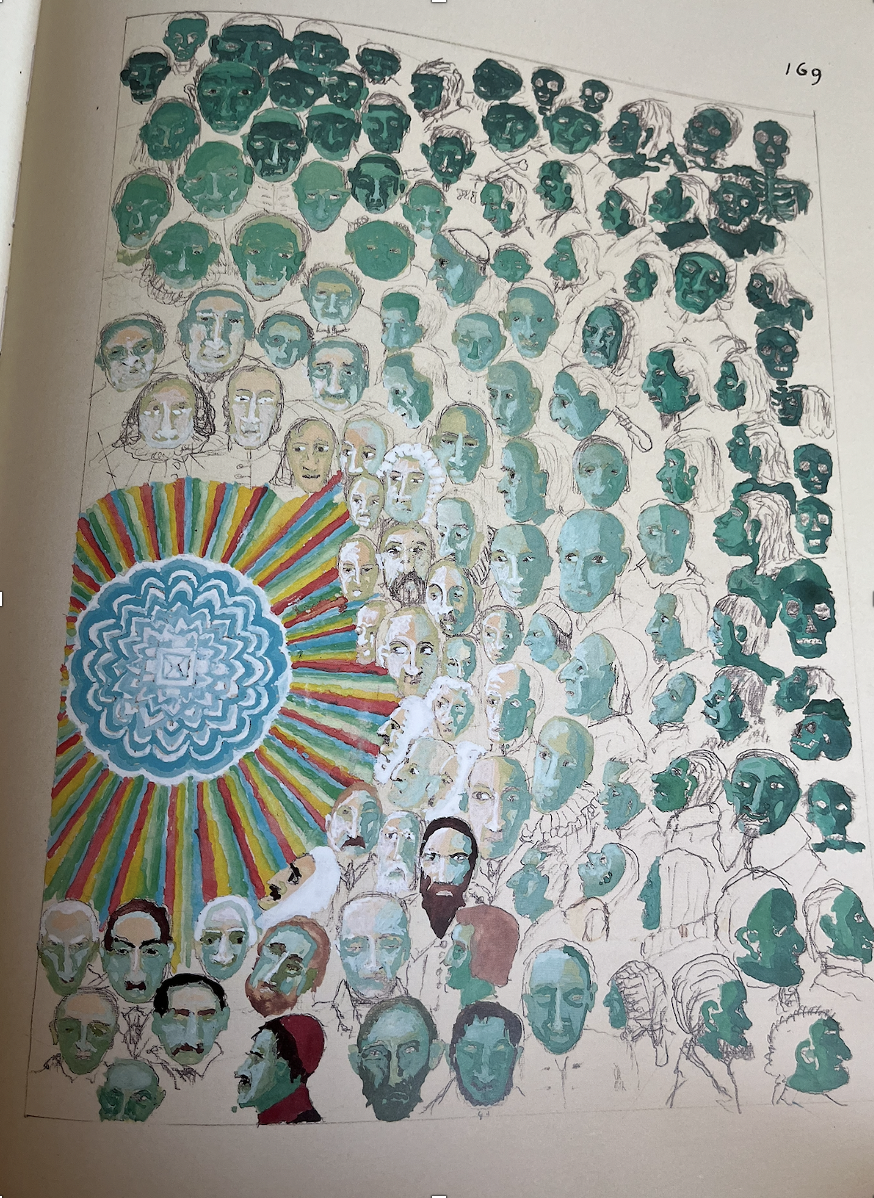
One image from The Red Book on page 169 can be seen as the forerunner of The Barbaric Yawp Project. Jung painted it in the aftermath of a visitation he had recorded in 1916. A hundred or so faces fill the page in graded greens, moving from a spectral wash in the upper right, where a small skeleton is visible, down through more individuated figures: bearded sages, white-wigged eighteenth-century philosophers, women in lace ruffs, one striking figure in a red cap. They are not threatening. They are massed, and they are waiting. To their left sits a radiant mandala — the symbol Jung came to use for the integrated Self, the round wholeness — its blue and white concentric scallops throwing off rays of red, yellow, green, and blue. He painted the crowd of the dead and the symbol of the Self together, and on purpose. Integrating the voices of the dead is part of the process of individuation, of becoming whole — whether in an individual or in a culture.
The video that follows is an active imagination of how Jung might answer the dead now — in an American moment when the institutions of memory are themselves being dismantled, and the question of how a culture stays in contact with its dead and its core values has become urgent in a way almost no one anticipated even a few years ago.
Visit The Barbaric Yawp Project website here.
After All the Leaves Have Fallen: Muslim Women and Their Traditions by Rochelle Shicoff
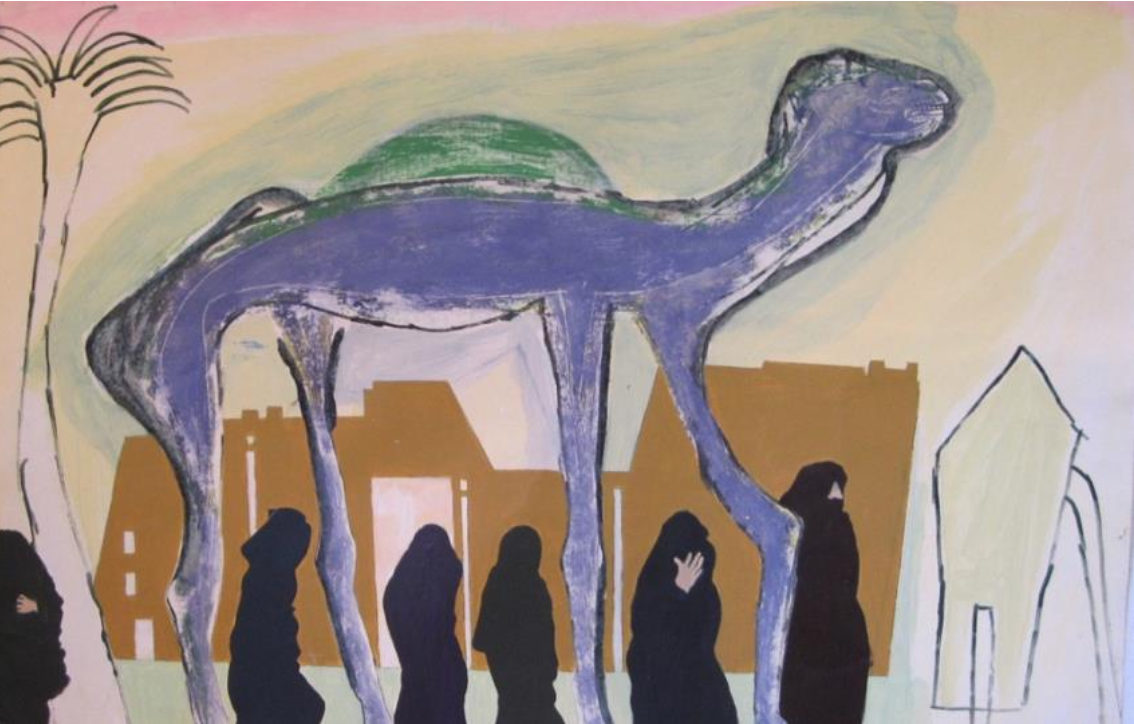
We are excited to highlight contemporary artist Rochelle Shicoff as she explores the symbolic content of her series of paintings, After All the Leaves Have Fallen: Muslim Women and Their Traditions. Drawing on years living among Middle Eastern neighbors in Brooklyn and a formative journey through Egypt, Shicoff fills her canvases with camels, patterned textiles, and veiled figures - symbols of strength, modesty, and endurance that honor the women she came to know.
We hope this feature builds a bridge between the historical material in the ARAS archive and the artists actively extending that visual language now.